
People living in the South Central coastal region of Bangladesh are struggling for survival facing extreme weather around the year due to global climate change. Observing the challenging situation and burning need of the striving people a group of philanthropists led by Mr. Edward Robin Bollove came forward in 2001 to form a local NGO, the Center for Rural Service Society (CRSS), with a commitment to eliminate the suffering of the deprived people and contribute in overall development of Bangladesh. The initial thinking was to work for the vulnerable communities living in the disaster-prone coastal areas of Bangladesh. After working for two decades with glorious achievement, now CRSS feels to expand its working area to other demanding regions and communities of the country, focusing poorly addressed sectoral issues. The journey started from the Barishal division, the southern coastal region of the country, and gradually expanded to other parts.
CRSS Vision
A self-reliant and poverty free Just society.
Mission:
To develop a society where all people, irrespective of gender, age, caste-race-religion, physical and financial inabilities, are enjoying a risk-free, environment-friendly, safe life with freedom, using optimum potential for improved livelihoods, availing all services dedicated to them with climate change adaptive technologies.
Objectives:
- To foster socio-economic development to poverty alleviation.
- To cooperate and enable the poorest mass to come under a united structural framework.
- To enable in ensuring the woman and child rights and rights of the third gender in the society.
- To ensure female participation in the socio-economic development efforts by providing them due organizational training so that their claim for justice and rights can properly be preserved.
- To build the rural women in such a manner so that they can grow with their own equitable duty and right-based consciousness.
- To establish social justice and equal rights.
Core Values:
- Primacy on human being for their survival and development in congenial environment.
- By love serve one other.
- Strict observance of organizational honesty, transparency and accountability.
- Practice of mutual respect and empathy.
- Maintenance of harmony with nature, community and other religions.
- Practice of peace, justice and equality.
- Maintaining gender equity with special emphasis on women empowerment and leadership for ensuring equal justice and dignity for all.
- Fosters a sense of community
- Respecting all living beings on earth with obligation to maintain ecological equilibrium.
- Strives for equality
- Embraces diverse groups of people
- Supports personal growth
Legal identity
CRSS got legal status from the following government departments to work as a NGO and welfare organization to support the disadvantaged, destitute and vulnerable people striving for better life.
| Date | Registration No. | Govt. Registration authority |
| 30 Sept. 2002 | Bari/927/02 | Department of Social Services (DSS), Ministry of Social Welfare, to work as NGO/ welfare organization |
| 05 July 2009 | 2465 | NGO Affairs Bureau (NGOAB); Prime Minister’s Office to avail external/ international support for development activities |
| 01 Aug. 2011 | 02593-01229-00583 | Micro Credit Regulatory Authority (MRA); Ministry of Finance, To work on micro-credit program |
| 03 Mar. 2016 | KHS-434/2016 | Registrar of Joint Stock Companies & Firms to work as a legal firm |
| 23 Feb. 2020 | Bari/46/2020 | Department of Youth Development, Ministry of Youth and Sports to work for youth |
| 20 Nov. 2013 | TIN No. 888967905174 | National Board of Revenue; to declare a tax paying organization |
| 23 Feb. 2022 | BIN No. 004534853-0804 | National Board of Revenue; to become a Value Added Tax (VAT) paying organization |
Working area
 CRSS is working in 7 upazilas (Barishal Sadar, Agoiljhara, Wazirpur, Gournadi, under Barishal district; Nesarabad under Pirojpur district; Kalapara under Patuakhali district and Bhola Sadar under Bhola district) of four districts under Barishal division. During next strategic period (2025-2030) CRSS will step up to other areas of Bangladesh considering need of the people looking for sustainable development overcoming socio-economic and environmental challenges.
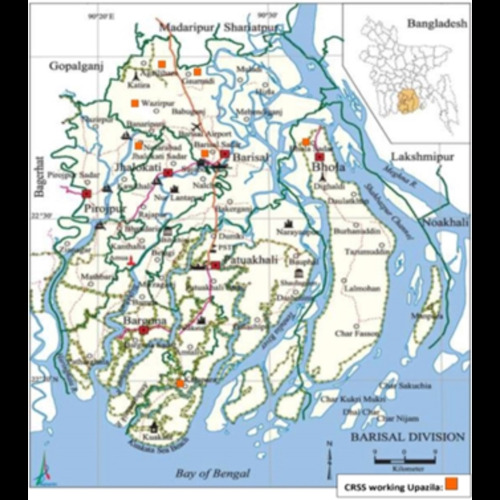
Initially currently unexplored vulnerable areas of Barishal division will be covered to support poor women and men; ethnic minorities, disadvantaged communities and people dependent on natural resources. Fisher-folk dependent on natural fish in the Bay of Bengal and rivers will be provided necessary technical support with modern and innovative livelihood options so that they can ensure proper earning during lean period and govt. declared off- season to catch fis from the Bay of Bengal.
Governance
CRSS in governed by a general body of 21 members including 7 member’s Executive committee. The body is elected for 3 years. Day to day activities is managed by the management body led by the Executive Director who is also member secretary of the executive body and executive director of the organization.

The Executive Committee
| Sl. No | Name | Designation | Qualification | Occupation |
| 01 | Mrs. Flowrence Annet Gupta | Chairman | B.A. B. Ed | Teacher |
| 02 | Md. Khandaker Nazrul Islam | Vice Chairman | MSS | Private Service |
| 03 | Mr. Edward Robin Bollove | Secretary/Executive Director | Bachelor of Social Science (BSS) | NGO Professional |
| 04 | Mrs. Shanchita Shikdar | Treasurer | M.Com | Private Service Asst. Manager of Janata Credit Union |
| 05 | Mrs. Monju Halder | Executive Member | BA | Teacher |
| 06 | Mrs. Zeenat Laila Shampa | Executive Member | MSc | Service |
| 07 | Mr. Amol Kumar Bose | Executive Member | BA.LLB | Business |
Timeline of CRSS development
CRSS timeline clearly shows its periodical growth steps by step growth gaining knowledge and capitalizing skills and potentials of the grassroots level partners and consultative interaction with development partners and stakeholders.
| CRSS started its journey (01 October 2001) | MILESTONES |
| 2001 | CRSS started journey (01 October 2001) |
| 2002 | Got registration from DSS Barishal (30 Sep. 2002) |
| 2003 | Formation of 40 groups by women at Barishal Sadar Upazila- Savings and Self-Help Credit |
| 2009 | Extension of Education for Credit Union Promotion (Ireland) |
| 2009 | Started working with Women’s Affairs for Vulnerable Group Development |
| 2011 | Got registration from Microcredit Regulatory Authority (01 August 2011) |
| 2016 | Started working with donor Micro credit for Mother (MvM) (date/year???) |
| 2016 | Registration from Joint Stock Company (03 March 2016) |
| 2016 | Started 1 year of piloting with World Vision Bangladesh on Community Engagement and Sponsorship Plan at Wazirpur |
| 2016 | Project on Grihayan Tohobil (House project) with Bangladesh Bank |
| 2019 | Started working with KNH on Self-Help Group and Child Protection (Piloting) at Bhola |
| 2020 | Emergency fund during COVID-19 from MvM (Food support and Health & Hygiene) |
| 2021 | Started 3 3-year full phased program with World Vision Bangladesh on Community Engagement and Sponsorship Plan at Wazirpur (extended for 1 year till Sep. 2025) |
| 2022 | Started projects on Climate Change at Wazirpur and Agoiljhara upazilas funded Kerk in Actie (3 years) |
| 2022 | Started project with women group members at Wazirpur, funded by KULA International The Netherlands (for 3 years and will be extended) |
| 2023 | Started projects on Climate Change at Kalapara upazila, funded Kerk in Actie (01 April 2023) (for 1 year) extended for one more year in 2024 |
| 2025 | Received funds from MvM on Micro-credit Loan for Mothers and IGA Training |
| 2025 | Gift of Love for underprivileged children; Samaritan Purse USA through Generation Bangladesh; This project is also aimed for children victims of Cyclone SIDR areas 2007 |
| ??? | Microcredit & Small enterprise loan program and institution building & skill development training, women empowerment; Group Savings RABO Bank Foundation, Netherlands through FOCUS- Bangladesh, Organizational own fund and groups savings. This program in ongoing with full swing |
| ??? | Promotion and Extension of Credit Unions & Women groups through training, structural formation and education components. International Development Foundation Ltd. (ILCU), Ireland. (Completed successfully) |
| ??? | Credit Union (CU) Promotion Program; RABO Bank Foundation Netherlands through FOCUS- Bangladesh, ILCUF- Ireland, CU Savings; (Completed successfully) |
| ??? | Emergency Relief program for Cyclone SIDR victims; Tear Fund Australia through HEED Bangladesh and Samaritan Purse USA through Generation Bangladesh, for 3500 SIDR victim families. (Completed successfully) |
| ??? | Environment & Development Program Training and improved local oven; Tear Fund Australia through HEED Bangladesh (ongoing) |
| ??? | Emergency Relief program for cyclone SIDR disadvantaged children victims; Samaritan Purse USA through Generation Bangladesh, for 3500 SIDR Disadvantaged children victims’ families. |
| ??? | Disaster Management Training, Primary Healthcare & Nutrition, and Capacity Building by HEED Bangladesh NGOs Networking program funded by Tear Fund Australia through HEED Bangladesh (completed successfully) |
| ??? | Vulnerable Group Development Program- VGD; Ministry of Women & Children affairs, Bangladesh |
| ??? | Vulnerable Group Development Program- VGD; Ministry of Women & Children Affairs, Bangladesh |
| ??? | Disaster Management Training, Primary Healthcare & Nutrition; and Capacity Building by HEED Bangladesh NGOs Networking program funded by Tear Fund Australia through HEED Bangladesh (completed successfully) |
Partnership
Since inception CRSS is working with many national and international development partners and donors. Some partnership is still continuing with successful completion of projects and on-going by phases.

Networking
CRSS has developed very good linkages with different networks functioning in the development sectors of Bangladesh. As active member of the networks CRSS keep close contact and working relationship with the members and participate in the network activities as per need.

Management Approach
CRSS always follows a participatory management approach in both program and organization management with due respect to opinions, comments, and ideas of all concerned. Inthe program management community, level participants get scope and priority to share their ideas, concerns, and opinions for successful implementation of the programs with optimum benefits. In organization management, the general body, executive committee, management staff, and program/ project staff can share innovative ideas, opinions for the smooth management of the organization. This participatory approach has greatly reduced hierarchical dominance by suppressing the voices of others at the lower level.
Strategic Plan (2025-2030)
CRSS developed its first Strategic Plan for 2010-2015 and second for 2015-2020, and third for 2020-2025 with own initiative involving staff only. The fourth Strategic Plan (2025-2030) was developed in April 2025, involving program/ project participants from the grassroots level to other stakeholders, development partners, NGOs, Government officials, and well-wishers of the organization. Thus, the third SP can claim a collective outcome addressing opinions, ideas, and expectations of all concerned. Major contents of the SP are divided into two parts i.e. Programs and Organization. Again, programs are divided into three sectors i.e., Social, Economic, and Environmental, including cross-cutting issues like gender and climate change adaptation. Strategic objectives for programs and organizations are as follows;
| Program Strategic Objectives | Organizational Strategic Objective |
| PSO2: Adaptation of digital technology in program implementation and sectoral development | OSO1: Develop human resources considering the program reorganization |
| PSO3: Emphasizing women, youth, adolescents, and hard-to-reach (Program participants) | OSO2: Resource generation and mobilization to attain self-sufficiency and sustainability |
| PSO3: Emphasizing women, youth, adolescents and hard-to-reach (Program participants) | OSO3: Strengthening internal control and management system |
| PSO4: Need-based expansion of services, ensuring available resource accumulation and research | OSO4: Adaptation of appropriate technology for steady organizational growth |